Code overview
Here is an overview of the energetic and kinetic equations and the modular structure of the code.
Free energy components
The total free energy, \(G_{\textsf{total}}\), of a state is approximated by summation of electronic, translational, vibrational, and rotational energy contributions, i.e.,
The electronic contribution, \(G_{\textsf{elec}}\), is taken from DFT. The translational contribution, \(G_{\textsf{tran}}\), is
where \(V\) is the standard molar volume and \(M\) is the molecular mass. The rotational contribution, \(G_{\textsf{rota}}\), depends on the geometry of the molecule,
Here, \(I\) and \(I_1\), \(I_2\), \(I_3\) are the inertia and three principle components of the inertia, respectively and \(\sigma\) is the symmetry number of the molecule. The vibrational contribution is computed using the vibrational frequencies, \(v_i\), accounting for all degrees of freedom not attributed to overall translational or rotational movement,
Molecules interacting with the surface can be assumed to experience no/hindered/full translational or rotational contributions. Molecules in the gas-phase have three translational and two/three rotational contributions for linear/nonlinear molecules respectively. The number of atoms comprising a state includes all mobile surface atoms, \(N_{\textsf{s}}\), atoms in the molecules interacting with the surface, \(N_{\textsf{m}}\), and atoms in the molecules moving freely as gases, \(N_{\textsf{g}}\). Thus, the number of degrees of freedom is:
The hindered model assumes that the surface-bound state has some fraction, \(\alpha\), of the translational and rotational energy of the corresponding free gas molecule:
Reaction barriers and energy
The forward and reverse reaction barriers are computed as the difference in Gibbs free energy between the transition state (TS) and initial state (IS) for the forward reaction,
and the transition state and the final state (FS) for the reverse reaction,
respectively. The reaction energies are computed as the difference in Gibbs free energy between each pair of initial and final states,
Energy span model
The energy span (ES) model is a way of describing the theoretical efficiency of the catalytic cycles using state energies derived from the first-principles calculations (Kozuch and Shaik, 2011). The TOF is given by the summation of the pairwise energy differences,
where the summation is taken over all transition states (\(T\)) and reaction intermediates (\(I\)) in the catalytic cycle. Indexing states \(T\) by \(i\) and \(I\) by \(j\), the term \(\delta G_{ij}\) is defined as follows:
The pairwise energy differences can be used to characterize the degree of TOF control of transition states,
and intermediates,
In this way, we can determine which states are the most TOF controlling, the so-called turnover-determining transition state (TDTS) and turnover-determining intermediate (TDI). These are the states with the largest energy difference across successive catalytic cycles.
Microkinetic model
A mean-field microkinetic model describes elementary steps occuring on a catalyst surface, including adsorption/desorption and reactions, assuming that the surface coverage is homogeneous. Reaction steps are formulated using the law of mass action. For each elementary step, \(i\), the reaction rate is given by,
and for each species, \(j\), the differential equation governing its rate of change is:
where \(\nu_{ij}\) is the stoichiometry of species \(j\) in reaction \(i\). In order to conserve the number of surface sites, with \(\theta^{\textsf{tot}}\) the normalised number of sites,
if there is a single site type, or
if there are multiple site types \(S_k\). This is achieved naturally by tracking all clean surface site types in the same manner as adsorbates. Then, the Jacobian for this system of differential equations is:
Reaction rate constants are typically taken to have an Arrhenius form, with the pre-factor determined from transition state theory,
where \(k_{\textsf{B}}\) is the Boltzmann constant, \(h\) is the Planck constant, \(T\) is the temperature, \(R\) is the gas constant and \(\Delta G_{\textsf{a}}\) is the activation free energy. The pre-factors for adsorption rate constants are instead determined using collision theory,
where \(A\) is the area of a site and \(M\) is the mass of the molecule. The reverse reaction rate constants can be computed from the corresponding equilibrium constants,
using the reaction free energy, \(\Delta G_{\textsf{r}}\) to ensure thermodynamic consistency.
The degree of rate control (DRC) is computed from the overall reaction rate,
and can be estimated numerically using finite differences to perturb the rate constants and describe the derivative.
Reactor models
Here, we consider a continuously stirred tank reactor (CSTR) model in which the mixture is assumed to be spatially homogeneous. A CSTR is parameterized by its residence time, \(\tau\) (i.e., the reactor volume, \(V\), divided by the flow rate, \(Q\)) and, for heterogeneous reactions occurring on a solid catalyst surface, the total number of catalyst sites (i.e., the site density, \(\rho_{\text{cat}}\), times the catalyst area, \(A_{\text{cat}}\)):
where \(S_i\) represents the sink/source term for mass transport to/from the surface from the gas due to adsorption/desorption respectively and
and
Structure of modules
PyCatKin is written using object-oriented programming. The central subpackage modules are defined as shown in the figure below:
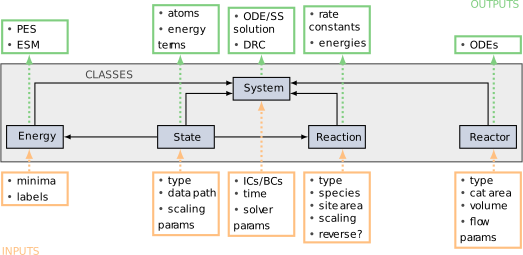
- The modules have the following functions:
State: A microscopic state, which can be either a surface, adsorbant(s) or gas molecule(s). Information stored can include mass and inertia, energetic terms, structure.
ScalingState: A microscopic state, which can be either a surface, adsorbant(s) or gas molecule(s). Superficially the same as an instance of State; however, energetic terms are defined by scaling relation.
Energy: An ordered collection of states defining a reaction energy landscape (which can be drawn). Energy span model calculations can be performed using its member functions.
Reaction: An elementary surface reaction. Defined by lists of reactant, product and transition state states, the site area on which the reaction occurs and the scaling (for example due to a non-unity sticking coefficient). Used to compute reaction energies and barriers, and thus, reaction rate constants.
Reactor: The system being studied. Can be either a CSTR or an infinite dilution reactor. Provides information about the boundary conditions (mass transport).
System: Defined by a set of states, a set of reactions, and a reactor, with parameters for initial and boundary conditions, and solver tolerances. Used to solve for transient or steady-state profiles of relevant species, compute the DRC, and to save results.
Uncertainty: Defined by a system, the mean and variance of Gaussian distribution, and the number of samples. Used to estimate the propagation of uncertainty in the energy landscape to the kinetics with a correlated error model.
The reaction rate constants, input parser and some preset simulations are defined in the functions subpackage and the physical constants are defined in the constants subpackage.